
The Cost of Carbon
Calculate your carbon travel footprint with this calculator from the International Civil Aviation Organization.
Not all “carbon footprint” calculators are made equal. Most lack critical information about their methods and estimates, which gives those who want to use them to understate their footprint some undeserved wiggle room (Padgett et al., 2008; Moore et al., 2025). In a world where increased leisure travel, and thus a larger carbon footprint, is positively associated with aspects of life satisfaction, it should come as no surprise that escaping guilt for one’s carbon-excess travel methods is desirable (Leferink et al., 2025).
This ICEC 2026 calculator calculates CO2 emissions across four cabin classes: Economy, Premium Economy, Business, and First. Furthermore, this resource provides two reports for their estimation methodology, outlining their data sources, fuel formulas, aircraft analysis, and more. See the graph below for a look into their general methodology.
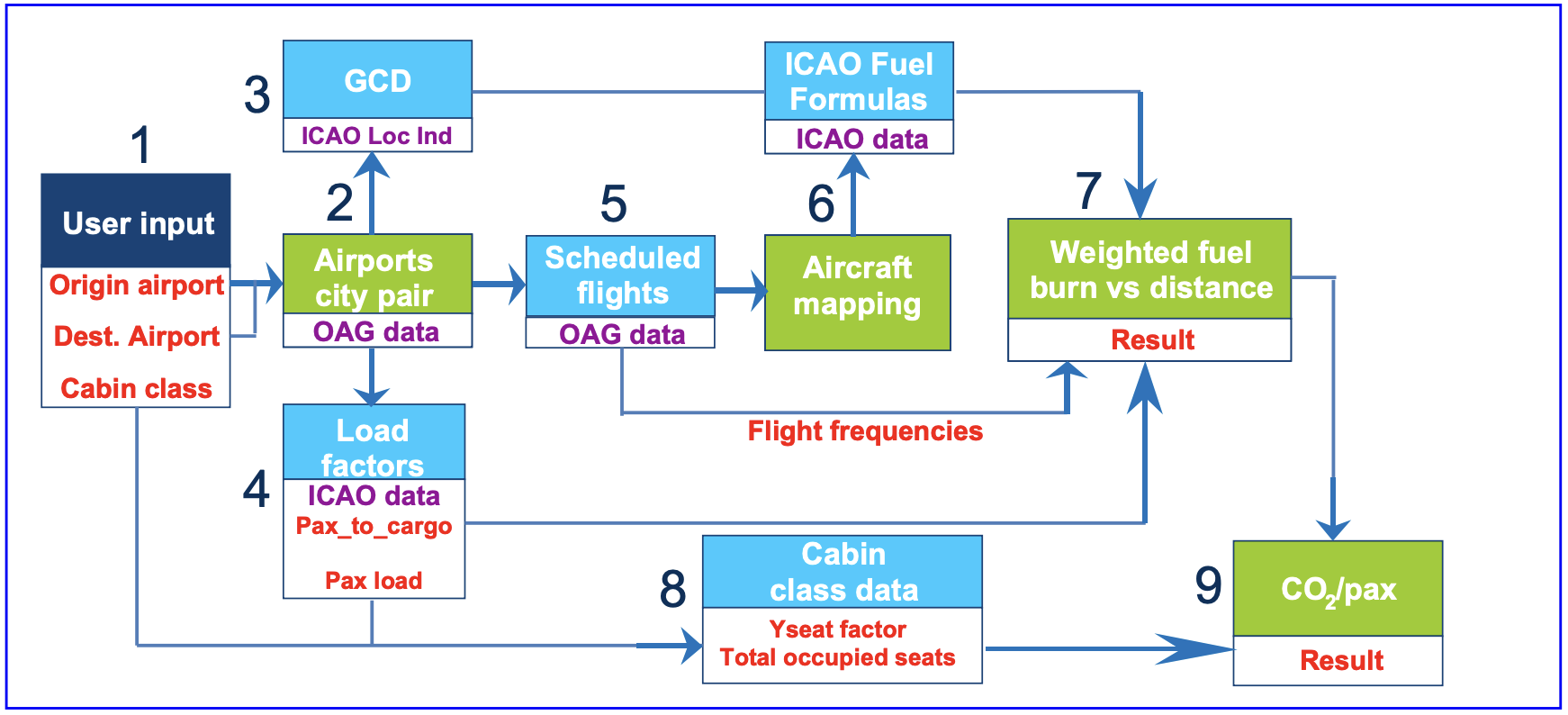
General methodology flow chart for the ICAO 2026 CO2 emissions calculator.
Globally, the power of individual actions relative to emissions is unfairly minimized, and the majority of the blame is put on governments and companies (Moore et al., 2025). While governments and companies are largely responsible, the minimization of individual actions completely ignores that our climate crisis is shaped daily by the cumulative decisions of everyday people. In addition to how people heat their homes and consume electricity, how they travel is often a major source of emissions (Shang et al., 2024).
During a semester abroad, students are likely taking the highest number of flights of their college years within a condensed time frame. This page asks you to consider the impact of your travel decisions. Use the calculator and see a Hamilton alum’s impact during their spring semester abroad in 2025.
Sources
International Civil Aviation Organization. (n.d.). ICAO carbon emissions calculator. https://icec.icao.int/
Leferink, E. K., Olson, S., Czepkiewicz, M., Árnadóttir, Á., & Heinonen, J. (2025). Are larger carbon footprints linked to higher life satisfaction? A study of the Nordic countries. Journal of Cleaner Production, 529, 146602. https://doi.org/10.1016/j.jclepro.2025.146602
Moore, C., Allasia-Grau, S., de Santana, T., Sauras-Yera, T., & Sabate-Jorba, S. (2025). A review and development of an enhanced carbon footprint calculator to facilitate knowledge of individual carbon emissions. Journal of Cleaner Production, 522, 146292. https://doi.org/10.1016/j.jclepro.2025.146292
Shang, W.-L., Ling, Y., Ochieng, W., Yang, L., Gao, X., Ren, Q., Chen, Y., & Cao, M.-Q. (2024). Driving forces of CO₂ emissions from the transport, storage and postal sectors: A pathway to achieving carbon neutrality. Applied Energy, 365, 123226. https://doi.org/10.1016/j.apenergy.2024.123226