The Numbers
Carbon dioxide levels in the atmosphere are 50% higher than pre-industrial levels (NOAA, 2022). 2025 finished as the third warmest year on record for the globe. From 1980 to August 2024, the U.S. alone has experienced 396 weather and climate disasters - the toal cost of these events to the economy is estimated at $2.780 trillion (NOAA, 2026).
Without an awareness of basic climate stats and projections, your decisions for your future are not well informed.
This page aims to give you a grasp of these numbers, no matter your background in climate science or education as a whole. If you have unanswered questions after reading this material, fill out the contact form at the bottom of the page. Thank you for your engagement.
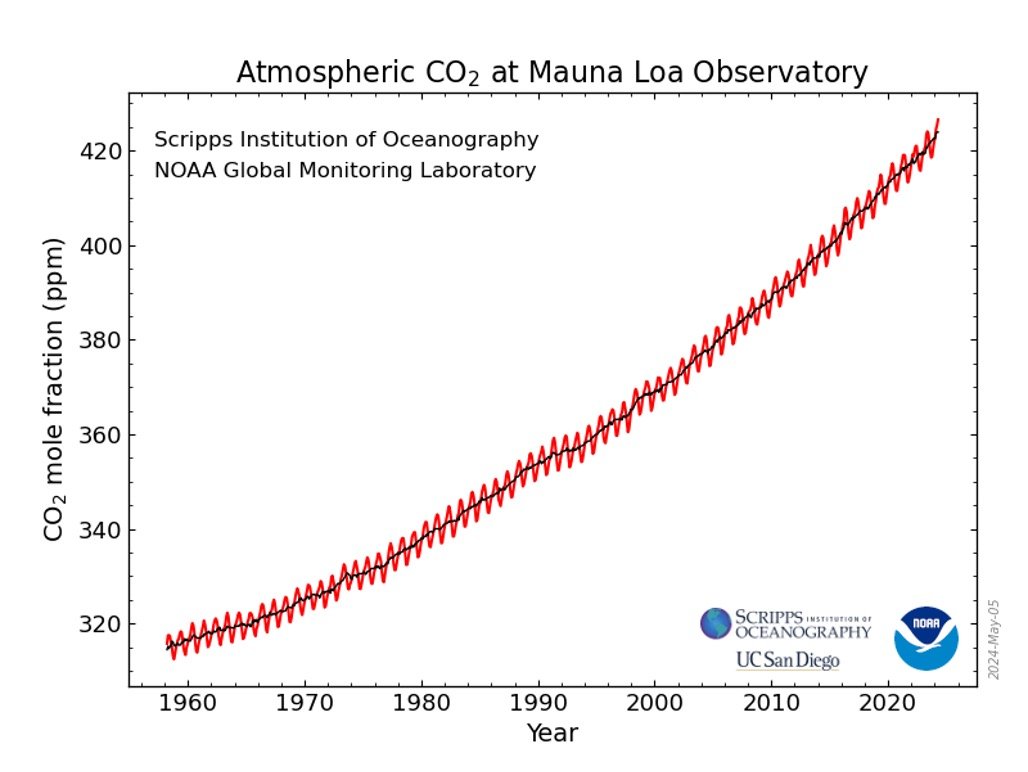
This graph shows you the monthly mean of carbon dioxide in the atmosphere, collected by researchers at Mauna Loa Observatory in Hawaii. This trend is mirrored by graphs representing global monthly means of CO2 levels. Clearly, the above levels are rising - but I want you to notice that they are not rising in the form of an exponentially devastating trend. Rather, this relatively linear trend should tell you that for every emission to the atmosphere, there is a proportional atmospheric effect. Therefore, every individual action matters. While you might assume individual climate responsibility pales in comparison to the actions of big fossil fuel emitters and the grid, and in many respects it does, this graph should communicate to you that your daily decisions do have an effect.
So now that we’ve debunked the myth that your daily actions have no impact, let’s get into the weeds with more global emissions, projections, and problems.
Learn the Basics: Climate Science, Risk & Solutions
Explore this public online resource from Dr. Kerry Emanuel, a professor of Atmospheric Science at MIT. Here you can find the beautiful basics of climate science, along with the challenges of climate change, its associated risks, and creative solutions.
FAQs
“I’ve heard that the ocean is carbon sink and it absorbs a lot of our emissions - people have told me that I shouldn’t worry so much about CO2e emissions because of this sink. Are they right?”
1
Yes and also absolutely not. Yes, they are right that the ocean is a carbon sink. However, humankind’s disproportionate CO2e emissions have stressed the ocean in ways that have killed off species, harmed communities dependent on marine systems, and created generation-lasting impacts. The ocean is at the limit of what she can handle - and we should not treat her like a landfill.
Ocean acidification, aka the decrease in seawater pH due to increased oceanic CO2 absorption, has caused the above impacts (USGCRP, 2018). This absorption is why the ocean is labeled as a carbon sink. Inland waters release roughly 247 Tg of carbon each year into the atmosphere, while simultaneously storing around 155 Tg of carbon annually in sediments (USGCRP, 2018). Tidal wetlands and estuaries together function as a net carbon sink, removing about 17 Tg of carbon per year from the atmosphere, with an additional 14 Tg buried in sediments each year (USGCRP, 2018). Meanwhile, the coastal ocean absorbs approximately 160 Tg of carbon annually from the atmosphere and stores about 65 Tg per year in sediments (USGCRP, 2018).
“I’m overwhelmed by these numbers. How can I help now while retaining hope for the future?”
2
There is no one, penultimate correct answer to this question… unfortunately. I think becoming comfortable with statistics and the papers at the bottom of this page can actually give you some peace of mind. You are responsible to your self and your community’s future - and unpacking the numbers are apart of that responsibility.
So my answer to this question is read more and talk more. Talk with your friends, family, whomever to collaborate with shared knowledge about climate action and resilience. You don’t have to be alone and overwhelmed - and I think a lot of hope is built in partnering with your neighbors and friends against whichever climate hurdles you currently have, and those you might have later.
“Do my transportation choices really make that much of a difference?”
3
“That much of a difference” means something different to everyone. If you are living in the US, a large country with minimal public transportation options, I do think your transportation choices make a difference. If you are in the position to purchase an electric vehicle, I think this investment is worth your time - especially with fossil fuels becoming increasingly expensive. Gradual transitioning of your energy sources to electric when you can is a fantastic contribution to our shared climate future.
Check to see if your state has incentives for EV purchasing - many credits have disappeared due to federal leadership - but knowing how your state can assist your transition away from fossil fuels is key.
“What sustainable practices in life can I adopt as a 20-something year old?”
4
Here are a few guiding questions you can reflect on to materialize the answer to this question, one that is specific to you, your needs, and your capabilities.
Are you interested in working from within the system or outside of it? The “within the system “ umbrella includes for-profit private sector / public sector work. The “outside of the system” umbrella includes non-profit work.
What do you care most about and how can your skills serve this value set? For example, I grew up in a coastal town - the ocean is at the heart of my family, social, and academic life. I know that I thrive in communal, close-knit environments with a common goal. Therefore, I know that I want to dedicate my life to the ocean environment’s protection while protecting those who depend on it. This realization led me to be keenly focused on educational and climate science research, specific to marine ecosystems.
How important is money to you? Do you want to invest in the future of your self as an individual, your community, the world? Establish how you want your relationship to your money to impact your relationships to your values, community, and climate.
“I’ve heard that 97% of scientists believe in climate change. Do the 3% have faith in a different causal reasoning for climate change?”
5
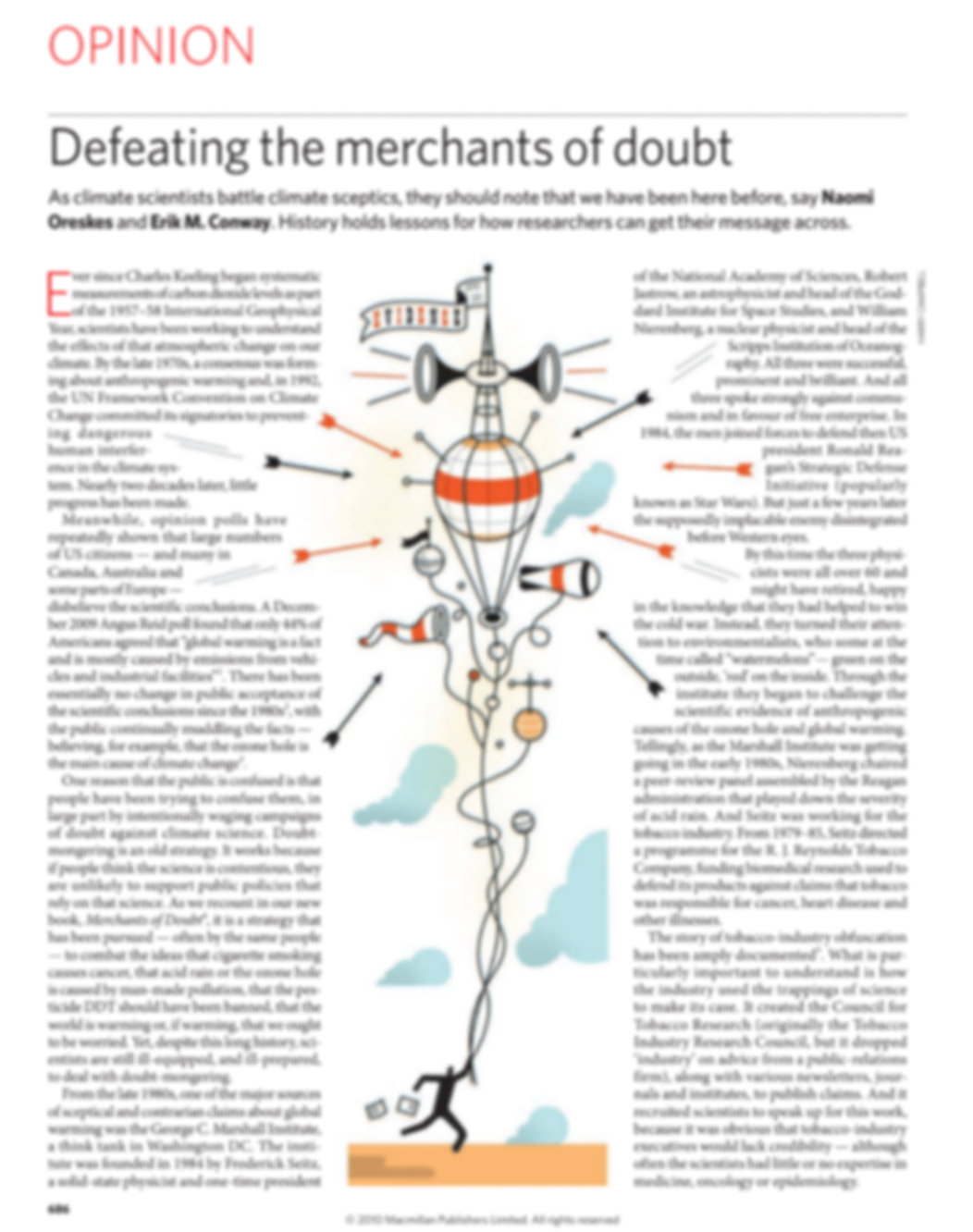
Over 99% of climate scientists agree that climate change is real and anthropogenically led - meaning caused by humans. This 97% statistic emerged from an old study that attempted to poll equally the ranges of the political and scientific spectrum - but in doing so created a skewed result that didn’t accurately capture current scientific belief. Ultimately, scientists agree that climate change is real but some disagree about the cause (human or otherwise). You can read more about how this 97% came to be in the 2010 opinion article from Nature titled “Defeating the Merchants of Doubt,” found above in the article section.